
Personal Context Infrastructure
Why Every Attempt at “AI That Knows You” Has Bet on the Wrong Layer
Divyaraj Chauhan
Writer
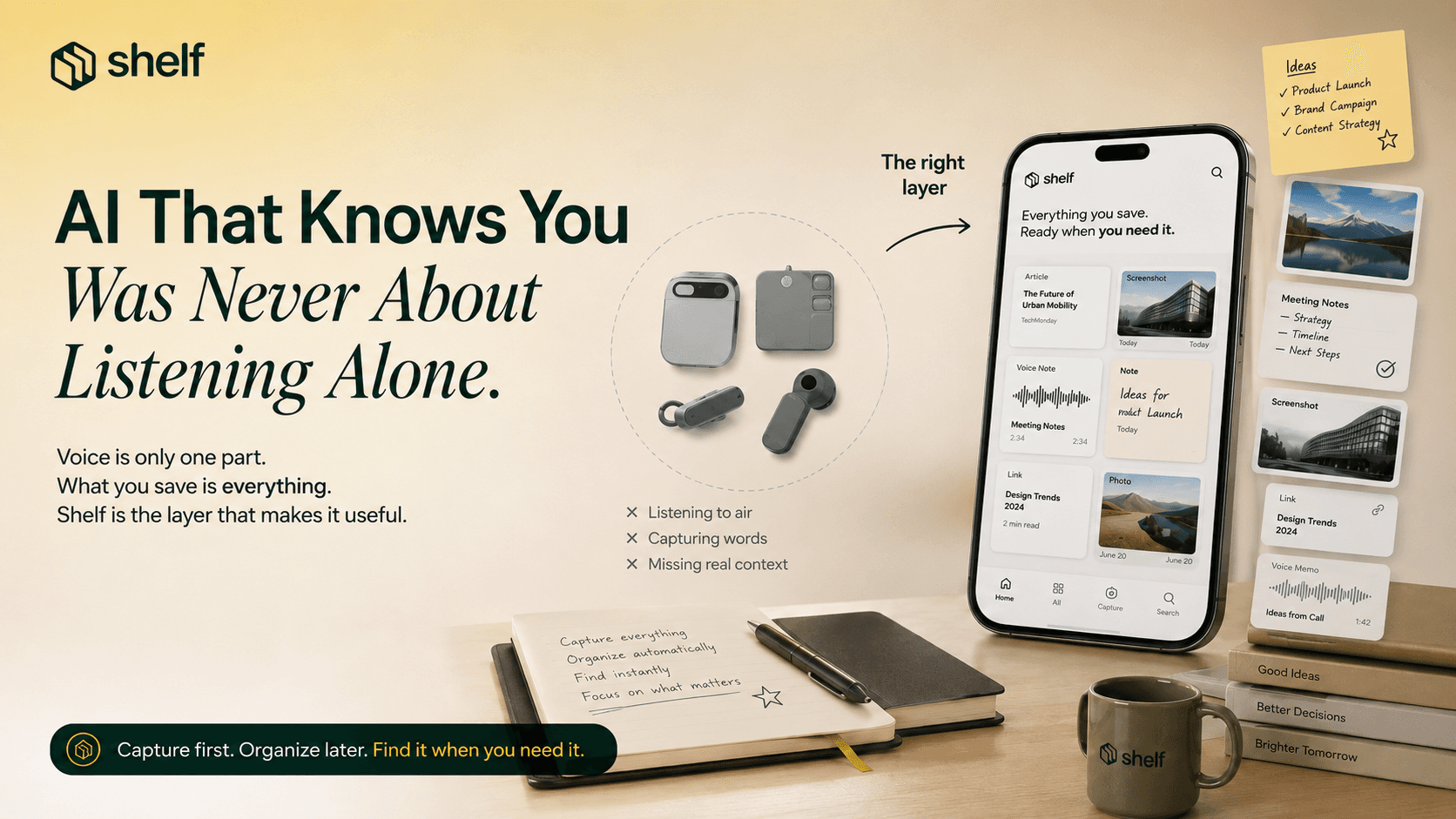
AI wearables focused on listening, but most personal context already lives in screenshots, links, notes and saved media. The missing layer is personal context infrastructure.
In 2023, Humane shipped the AI Pin — a wearable that clipped to your shirt and listened. Rabbit shipped the R1 — a pocket device that listened differently. Limitless shipped a pendant. Bee shipped a clip. Omi shipped an earpiece. Friend shipped... a friend.
Every one of these products made the same fundamental bet: the right layer for personal AI is hardware you wear, capturing through voice.
That bet has largely failed.
The Humane AI Pin was returned en masse and the company sold off. The Rabbit R1 became a cautionary tale about shipping without a foundation. Limitless was absorbed into Meta. Bee was absorbed into Amazon. The wearable wave crested and broke faster than almost anyone predicted.
The common autopsy says: bad execution, wrong price points, insufficient AI capability. These diagnoses are accurate. But they miss the structural problem underneath.
The bet itself was wrong.
Why Voice Is The Wrong Layer
Voice is a narrow channel.
A typical person speaks roughly 16,000 words per day. Some of that is genuinely context-rich — a conversation with a colleague about a real decision, a call with a doctor, a meeting where strategy actually gets made. Most of it is ambient noise: pleasantries, orders at coffee shops, half-sentences to nobody in particular.
But the more fundamental problem is what never gets spoken at all.
The article you bookmarked at midnight because it reframed something you'd been thinking about for months. The screenshot of a product page you saved three days before buying. The voice memo you recorded while driving home because something clicked. The notes app entry that started as four words and never got finished. The photo of the whiteboard from the meeting where everything changed.
None of that goes through voice. None of it appears in a transcript. None of it gets captured by a device listening to the air around you.
Most of what constitutes your real context — your actual interests, your decisions, your evolving understanding, your open questions — lives in silent, fragmented, already-saved form across the apps on your phone.
The wearables weren't capturing what you know. They were capturing what you say. These are not the same thing.
The Layer That Was Already There
The phone is already the default capture surface for human context.
Not by design, exactly. Nobody at Apple or Google sat down and decided to build the world's best personal context repository. It happened by accumulation. The camera became the best camera. Notes became frictionless. The share sheet made it easy to save anything from anywhere. The action button made capture faster still. Every productivity app built a share extension. Every browser built a reading list.
The result is that most of what a person saves, thinks, and researches now lives on one device. Links, screenshots, voice memos, notes, bookmarks, reading highlights, calendar entries, reminders, photos of documents. The raw material of a person's intellectual life is already there, already captured.
What is not there — what has never been there — is an organizing intelligence on top of it.
That is the missing layer.
Not more hardware. Not better microphones. Not a pendant that listens while you sleep. An intelligence layer over what you are already saving, paired with the trust architecture to hand that context to AI safely — without handing over everything, without losing control of where it lives.
This is a Category Problem, Not a Feature Problem
The reason this keeps getting framed as a hardware problem — or an AI problem, or a UX problem — is that the category itself hasn't been clearly named yet.
"Second brain" tools like Obsidian, Notion, and Roam got close to naming it. But they required too much deliberate input. You had to choose to organize, choose to link, choose to maintain. The tools became a second job instead of a second brain. Most people who started using them stopped.
Cloud storage providers got a different piece of it. Google Drive, iCloud, and Dropbox solved the "where does this live" problem adequately. They never touched the "what does it mean and how do I use it" problem at all.
Ambient wearables tried to solve the capture problem in a way that didn't require deliberate input — passive listening as a workaround for the friction of active saving. But they solved the wrong capture problem. Active saving had already been solved. The phone had solved it.
The category that's missing is what you might call personal context infrastructure: a layer that sits over what you're already saving, makes it legible and searchable, understands it well enough to assist you — and exposes it safely to the external AI tools you're using, only on your terms.
This is not a note-taking app with better AI. It's not cloud storage with smarter search. It's not a wearable that works. It's a new category, positioned against all three of those at once.
Why Now
Three things changed at roughly the same time that make this category buildable today in a way it wasn't in 2022.
First, large language models became capable enough to reason over personal, heterogeneous data — not just structured databases, but the messy, mixed-format reality of what actually lives in someone's saved files.
Second, on-device AI matured enough to handle significant processing locally. Which means the trust question — does this company have all my private notes? — has a credible architectural answer for the first time.
Third, MCP (the Model Context Protocol) created a standard mechanism for exposing structured context to external AI agents. Personal context infrastructure now has an interoperability layer to build toward, not just a private silo to build into.
The hardware bets on ambient wearables were, in part, premature. The category they were trying to serve is real. The layer they chose to build on was wrong, and the infrastructure to do it right didn't fully exist yet.
Both of those conditions have changed.
This is the first article in a series exploring Personal Context Infrastructure—the emerging category between AI wearables, cloud storage and personal knowledge-management tools.
Comments
No comments yet. Be the first to share a thought.