
Personal Context Infrastructure
What Killed the AI Pin: A Post-Mortem on Humane, Rabbit, and the Wearable Wave
Divyaraj Chauhan
Writer
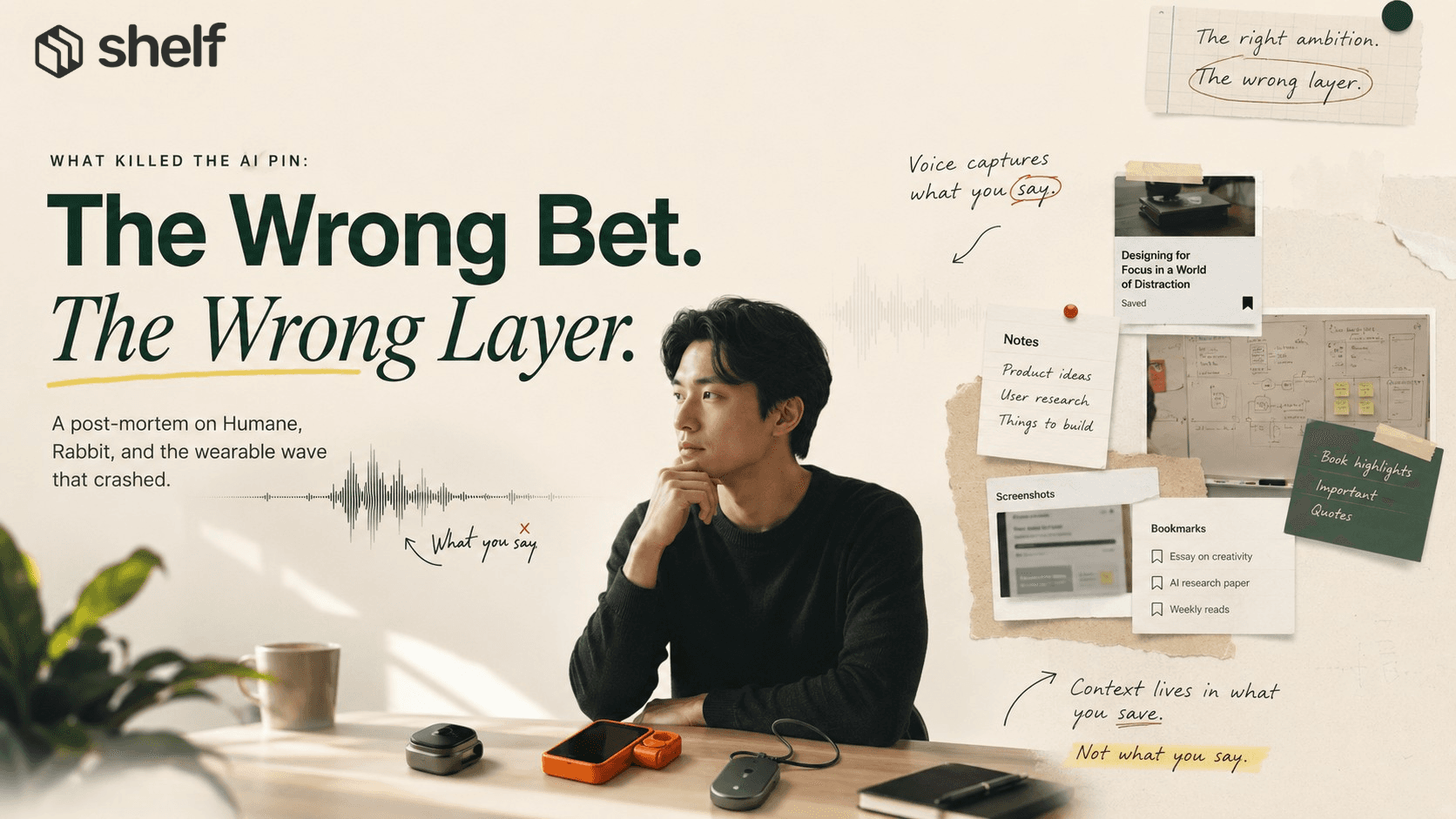
Humane, Rabbit and the wearable AI wave did not fail only because of poor execution. They were built on the wrong input layer: ambient voice.
The year 2023 looked, briefly, like the beginning of something.
Humane — founded by two former Apple designers, backed by $230 million from investors including Sam Altman — unveiled the AI Pin at a Paris fashion show. It clipped to your chest like a brooch. A laser projected information onto your palm. It was meant to be, in the company's words, "a new relationship with technology."
Twelve months later, Humane sold to HP for a fraction of its valuation. The AI Pin was discontinued. Users who'd paid $699 plus a monthly subscription were told their device would stop working.
The Rabbit R1 — a $199 orange plastic device with an eye-catching design and a concept called the "Large Action Model" — sold out its first batch in 24 hours on the strength of a viral CES announcement. Reviewers discovered it couldn't reliably do what was demonstrated on stage. Within months, one developer had shown that its entire functionality could be replicated as a smartphone app.
Limitless, which made a recording pendant for meetings, was acquired by Meta. Bee, another conversation-capture wearable, was acquired by Amazon. Neither acquisition was celebratory — both read as acqui-hires, the products quietly wound down.
The wearable AI moment arrived, generated enormous press, and evaporated.
What actually happened?
The Autopsies Were Right, and They Missed the Point
The product-specific explanations for each failure are accurate.
The AI Pin overheated. Its laser projector was nearly invisible in daylight. Its response times were too slow for a device that replaced a phone. At $699 plus $24 a month, it cost as much as a smartphone while doing a fraction of what a smartphone does.
The Rabbit R1's core concept — a model that learns to operate apps on your behalf — was architecturally sound as a long-term vision and completely unbuilt at launch. The device that shipped was a voice interface to a handful of APIs, wrapped in hardware nobody needed.
The meeting-recording pendants (Limitless, Bee, Omi) solved a real problem — capturing what was said in conversations — but discovered that most people either didn't want a recording device visibly around their neck, or were surrounded by colleagues who didn't want to be recorded, or both.
Each of these failures is real. But notice what they all have in common beyond their individual problems: they are all failures of execution around a shared premise. The premise itself went unexamined.
The Premise Nobody Questioned
Every ambient wearable was built on the same assumption: that the right input layer for personal AI is the body.
Specifically, audio from the body. A microphone worn on or near the person, capturing what they say and what is said around them, feeding that stream into AI systems that would extract meaning, surface memory, and provide assistance.
This premise has a seductive logic. The AI learns from what you do and say, continuously, without requiring you to do anything deliberate. Zero friction. Ambient intelligence. The computer that disappears into your life rather than demanding your attention.
The problem is that most of a person's real context is not acoustic.
Think about the information that actually shapes your decisions and thinking. The articles you read late at night and bookmarked. The product page you saved before you bought something. The notes app entry you made three days ago that you still haven't processed. The photo of the whiteboard from the meeting where everything changed. The reading highlight from the book you finished last month. The link someone sent you that you forwarded to yourself to deal with later and never did.
None of that is captured by a microphone. None of it appears in a transcript. The ambient wearable, by definition, misses all of it.
The wearables were capturing the wrong signal. Voice is what you say. Context is what you know. These overlap far less than the premise assumed.
The Capture Problem That Was Already Solved
Here is the other thing the post-mortems tend to miss: active capture — saving information for later retrieval — had already been solved before any of these products launched.
Not elegantly, not perfectly, but functionally. The share sheet. The notes app. The reading list. The screenshot. The action button. Voice memos. Every major productivity app built a save-to integration. Every browser built a way to clip and store.
The result is that most people with a smartphone are already capturing enormous amounts of context, every day, without effort. The friction of capture had already dropped to something like two or three seconds for most common cases.
The wearables were racing to solve a problem that had largely been solved, using a method (ambient voice) that captured less valuable information than what people were already capturing deliberately.
The friction problem was real. They just identified the wrong friction.
What Was Missing, and Still Is
The actual unsolved problem isn't capturing more. It's making sense of what's already been captured.
Most people have years of saved links they've never returned to. Notes apps with hundreds of entries, never searched. Screenshots that live in the camera roll with no retrievable label. Voice memos that describe something important from eighteen months ago, indistinguishable in the list from a grocery note.
The captured material exists. The intelligence to make it useful doesn't.
That's a different product category than an ambient wearable. It's not a capture device. It's an organizing layer — software that sits over what you're already saving, understands it well enough to surface what's relevant when you need it, and can hand context safely to the AI tools you're actually using day to day.
The wearable companies had the right instinct — AI that knows you, context that follows you — and the wrong layer. They built hardware when the gap was software. They listened when the problem was organization.
The Lesson Is Not "AI Wearables Are Impossible"
It would be easy to read this post-mortem as evidence that AI ambient computing is a dead end. That's not the argument.
The argument is more precise: the ambient wearables bet on voice as the primary channel for personal context, and voice is the wrong channel because it's too narrow and it misses too much. A wearable that solved the right problem — exposing the full range of what a person actually saves and thinks about, across all their apps, in a trusted way — would be genuinely useful. Nobody has built that yet.
What's been built, and failed, is the premise that listening to air around you is a useful proxy for understanding who you are and what you care about.
It isn't. The information that matters most about you isn't being spoken. It's being saved.
Part of a series on the Personal Context Infrastructure field.
← Previously: Why Every Attempt at "AI That Knows You" Has Bet on the Wrong Layer
Comments
No comments yet. Be the first to share a thought.